
How Long Does It Take to Get a BJJ Blue Belt?
The blue belt is the most misunderstood rank in BJJ. Here's what it actually takes — and what it means when you earn one.
No belt in Brazilian Jiu-Jitsu gets more attention than the blue belt. It's the first rank beyond white — the proof that you've survived the hardest part of the journey — and it takes most practitioners longer to earn than any other promotion. That's not an accident. (New to the ranking system? Start with our overview of all BJJ belts in order.)
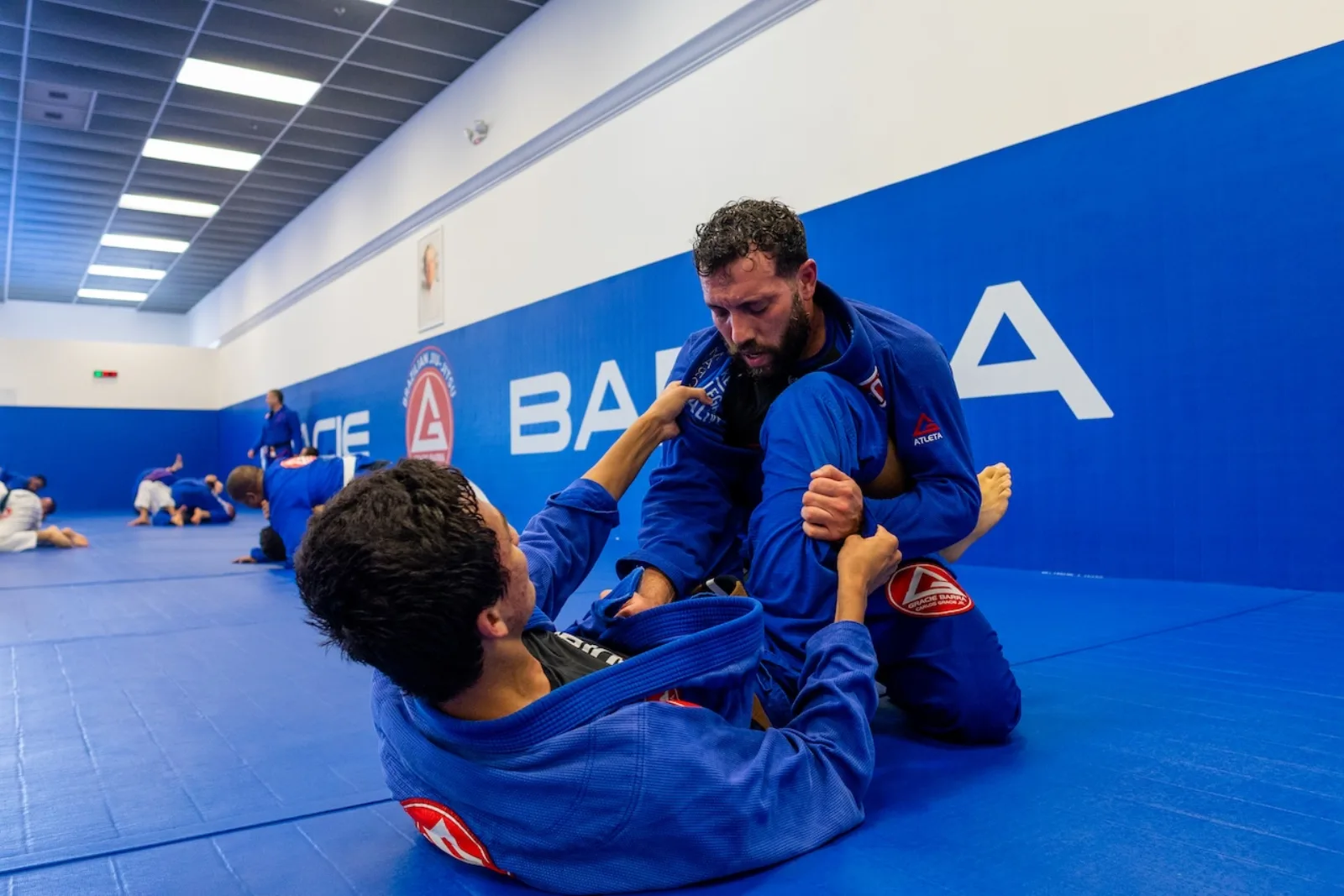
How Long Does It Actually Take?
A survey of 1,948 BJJ practitioners by Gold BJJ found that the average time to earn a blue belt is approximately 2.3 years of consistent training. The range is wide: some dedicated students earn it in 18 months; others train for 3+ years before their instructor feels they're ready.
Several factors affect the timeline:
- Training frequency. Practitioners who train 4–5 days per week progress significantly faster than those training 2 days per week. Time on the mat is the single biggest variable.
- Prior grappling experience. Former wrestlers, judoka, or submission grapplers may progress faster because movement patterns transfer.
- Training environment. A school with good instruction, consistent partners, and regular drilling produces faster development than one with high turnover and inconsistent coaching.
- Competition. Competing accelerates development by exposing gaps that don't always show in the gym. Many instructors promote students faster after they compete consistently.
What Are the IBJJF Requirements?
The International Brazilian Jiu-Jitsu Federation (IBJJF) sets minimum age and time requirements for adult belt promotions. For the blue belt, the requirement is:
- Minimum age: 16 years old
- No minimum time at white belt (unlike later ranks, IBJJF doesn't specify a minimum white belt duration — that's left to the instructor)
Once at blue belt, the IBJJF requires a minimum of 2 years before promotion to purple belt. This is the longest single waiting period in the adult belt system and reflects how much depth there is at blue belt level.
What Do You Need to Know?
There's no universal curriculum for blue belt, but most Gracie Barra-lineage schools expect practitioners to demonstrate solid fundamentals across all core positions before promotion:
- Guard play — basic closed guard, open guard retention, guard passing fundamentals
- Mount control and escapes — maintaining top mount and bridging/shrimping out from bottom
- Back control — taking the back and applying the rear-naked choke; escaping back control
- Side control — maintaining and escaping; transitions to mount and knee-on-belly
- Basic submissions — armbar, triangle, kimura, guillotine, rear-naked choke
- Takedowns — at least 2–3 functional takedown entries
- Conceptual understanding — position before submission; recognizing dominant and inferior positions
More important than any specific technique checklist: a blue belt should be able to roll with other white belts and consistently control the situation. Technical competence is measured live, not on paper.
The Blue Belt Blues
One of the most discussed phenomena in BJJ is the "blue belt blues" — a period of demotivation that often hits shortly after earning the blue belt. After months of working toward a goal, the promotion arrives and a question follows: now what?
At the same time, blue belts become targets. White belts want to beat you. Other blue belts view you as a measuring stick. The honeymoon of being a complete beginner is over.
This is also the belt at which attrition is highest. Studies of BJJ participation suggest a significant portion of blue belts stop training before reaching purple. The practitioners who push through this period often describe it as the most formative stretch of their BJJ development — the point where the art became genuinely theirs rather than a series of drilled movements.
How Is the Promotion Given?
At most schools, blue belt promotions are made at the instructor's discretion — there's no test, no checklist you submit, no scheduled evaluation. Your instructor watches you train over months and years. When they feel you've earned it, you get promoted.
At Gracie Barra, students also accumulate stripes on their white belt as they progress — up to 4 stripes before blue belt promotion. Each stripe is its own milestone, acknowledging consistent progress and giving students a visible marker of development on the way to their first rank.
What Does a Blue Belt Actually Mean?
A BJJ blue belt means you understand the fundamental language of the art. You know the positions, can execute the basic submissions, and can survive rolling with higher belts long enough to learn something. You're no longer just surviving — you're starting to play the game.
More importantly, a blue belt in BJJ means something because it's earned through live competition against resisting partners. Unlike arts where rank can be purchased or tested through choreographed sequences, your blue belt reflects what you can actually do when someone is genuinely trying to submit you.
A 2024 study of 410 BJJ practitioners found that higher belt ranks correlated with significantly greater mental toughness, grit, and self-efficacy. Blue belt is the first step up that ladder — and the research suggests the development is real, not just perceived. (de Lorenzo-Lima, 2024)
The path to blue belt is 2–3 years of consistent training, roughly 100–200 mat hours, and the humility to learn from everyone who taps you. Most people who start BJJ don't reach it. The ones who do rarely quit.
If you're just starting that journey in the Davenport area, our adult BJJ program runs Monday through Friday. Come in for a school tour and see what the first step looks like.