
BJJ for Kids: Benefits Every Parent Should Know
Why Brazilian Jiu-Jitsu is one of the best things you can put your child in — and what the research actually says.
Every parent wants their child to be confident, disciplined, and capable of handling whatever life throws at them. Brazilian Jiu-Jitsu delivers on all three — and backs it up with a body of research that most after-school activities can't match.
BJJ is a grappling martial art that teaches kids to control and submit opponents using leverage and technique rather than size or strength. There's no striking in class. No punching, no kicking. What kids learn instead is how to use their body intelligently — and that lesson extends far beyond the mat.
What the Research Says
Martial arts have been studied extensively for their effects on children, and the findings are consistent. A 2025 review in Primary Care Considerations for Youth Martial Arts Athletes found that martial arts training significantly enhances mindfulness, reduces stress, and improves self-control in school-aged children — with measurable reductions in bullying behavior as a secondary effect.
A 2019 study by Greco specifically examining karate as an anti-bullying tool found that youth with higher resilience and self-efficacy — the exact qualities martial arts build — were significantly less likely to engage in aggressive behavior or become victims of bullying. The mechanism isn't just physical confidence: it's the internalized sense that they can handle difficult situations.
On the physical side, a 2021 study by Detanico found that regular BJJ practice produces measurable improvements in body composition and muscle strength in both upper and lower limbs — without creating muscular imbalances. For a growing child, that's a meaningful finding.
Confidence That Comes from Real Skill
The confidence BJJ builds in children is different from the kind you get from participation trophies. It comes from genuinely learning something hard, failing at it repeatedly, and eventually succeeding through effort.
When a child earns a stripe on their belt, they know they earned it. When they pull off a technique they've been drilling for weeks, that moment of mastery belongs entirely to them. That kind of confidence — rooted in real competence — is what transfers into the classroom, onto the playground, and into every situation where a child needs to believe in themselves.
Discipline Without Yelling
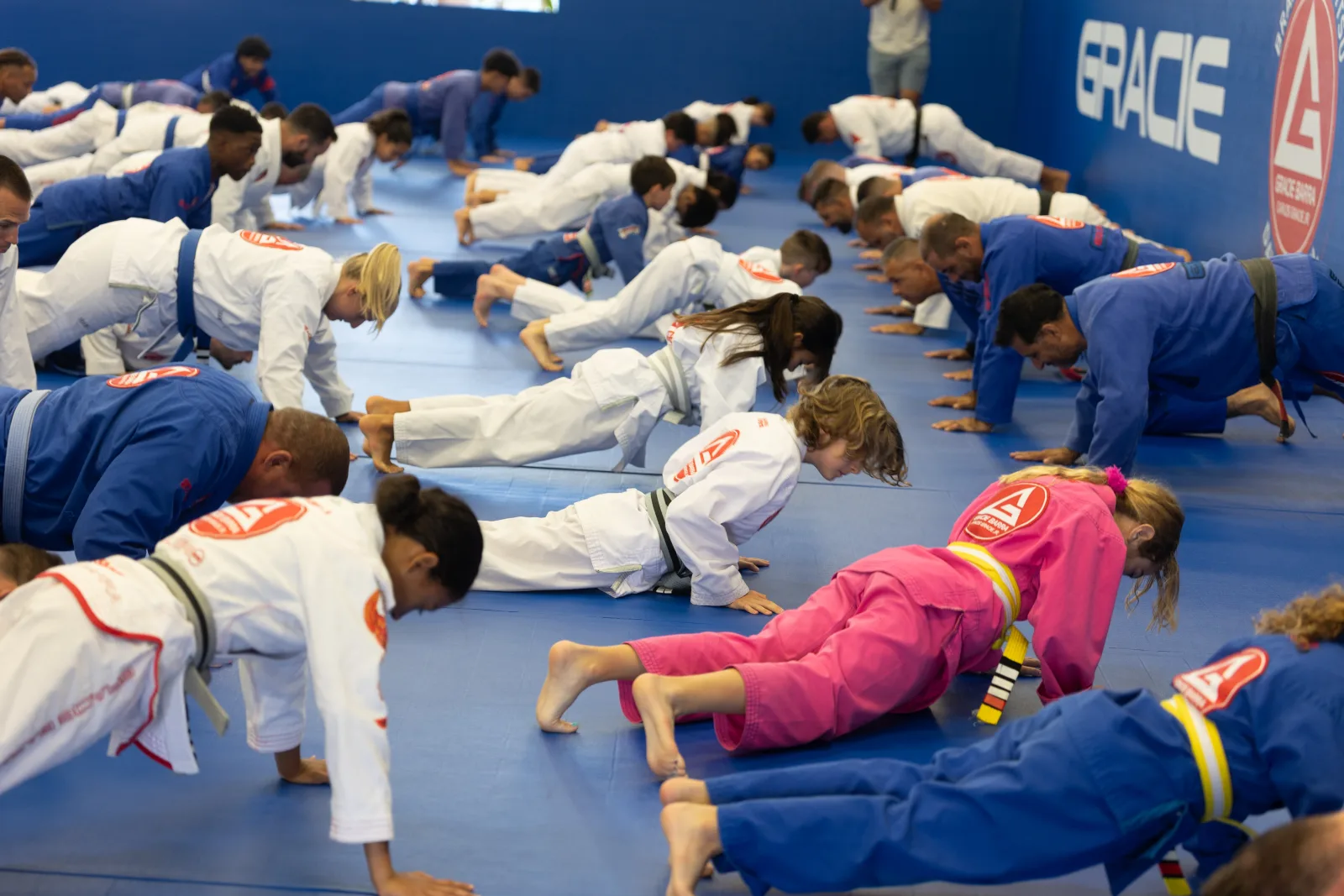
BJJ gyms are structured environments. Students line up, bow in, follow instructions, and respect their coaches and training partners. There's a culture of discipline embedded in the art — not because anyone forces it, but because the training only works when everyone takes it seriously.
Kids pick this up quickly. The same focus that helps a child listen to a technique breakdown in class is the focus that helps them sit still in school, complete homework without constant reminders, and manage impulses in social situations. Parents who've had kids in BJJ for a few months routinely report changes in behavior at home that they weren't expecting.
Real Self-Defense Skills
This is the practical side most parents care about: what happens if someone grabs my child, shoves them, or gets physical on the playground?
BJJ teaches exactly those scenarios. How to break a grab. How to stay safe if taken to the ground. How to create distance and disengage. Because it's practiced against resisting partners in class — not just drilled in the air — the skills actually work when needed.
Importantly, BJJ also teaches kids when not to fight. The culture emphasizes de-escalation, walking away, and using physical techniques only as a last resort. The child who trains BJJ is typically less likely to get into fights, not more — because they're not looking for a way to prove themselves.
Physical Fitness That Doesn't Feel Like Exercise
Getting kids to exercise consistently is one of the harder parenting challenges. BJJ solves it by making movement the point, not the goal. Kids are so focused on learning techniques, drilling with partners, and trying to improve that they don't notice they've been working hard for 50 minutes.
A regular BJJ practice builds cardiovascular endurance, flexibility, coordination, and functional strength — all things a growing child needs, and all happening naturally through the structure of the class.
Social Skills and Teamwork
BJJ is an individual sport that's trained in a team environment. Every class involves working closely with training partners — you need to communicate, cooperate, and trust the person you're rolling with. Kids learn to shake hands before and after every round, to tap when they're caught (rather than fight and get hurt), and to help their partners learn, not just try to beat them.
For kids who struggle socially or have difficulty making friends, the shared challenge of BJJ training creates natural bonds. Students who struggle together and improve together develop genuine camaraderie.
Is BJJ Safe for Kids?
Yes — and it's worth being specific about why. BJJ contains no striking, so there's no risk of punches or kicks during training. Techniques are applied with control, and the tap system means any discomfort ends immediately. Classes are supervised by experienced coaches who match training intensity to skill level and age.
Like any physical activity, minor bumps and bruises happen. But the injury profile of BJJ is comparable to recreational soccer or gymnastics — and significantly lower than sports like football or wrestling where contact is unavoidable and uncontrolled.
Age Groups at Gracie Barra Davenport
Our Kids BJJ program is structured into three age groups so every child is learning with peers at a similar developmental stage:
- Tiny Champs (ages 4–5) — fundamentals through games and movement; the focus is fun and building body awareness
- Little Champs (ages 6–9) — core techniques introduced with partner drilling; kids begin to develop real BJJ skills
- Juniors (ages 10–14) — more advanced curriculum with controlled sparring; students begin to compete if they choose
All kids classes run 50 minutes, Monday through Friday at 4:00 PM (Tiny), 4:50 PM (Little Champs), and 5:40 PM (Juniors). Kids follow their own belt ranking system with additional colors between white and black that acknowledge incremental progress.
What Age Should My Child Start?
We accept kids as young as 4 in our Tiny Champs class. At that age, the curriculum is heavily play-based — the goal is building coordination, listening skills, and comfort on the mat, not technical mastery.
Children who start between 6 and 9 tend to progress quickly because they can absorb technique more readily while still being in their prime athletic development years. Starting as a teen (10–14) is equally valid — older beginners often pick up concepts faster and have the focus for more detailed instruction.
There's no wrong age to start. The best time is whenever your child shows interest.
What Should My Child Wear?
For the first class, comfortable athletic clothing is fine — we'll take care of the rest. As they continue, kids will need a Gi (the traditional uniform). We can point you toward the right size and where to get one after that first visit.
Frequently Asked Questions
Is BJJ better for kids than karate or taekwondo?
It depends on your goals. If self-defense is a priority, BJJ is widely considered the most practical option since the techniques work in real grappling situations rather than requiring ideal striking conditions. For discipline and focus, all martial arts deliver those benefits. Many families choose BJJ specifically because the live sparring component means kids develop real, tested skills — not just patterns practiced in the air.
My child is shy and not very athletic. Will they fit in?
BJJ is one of the best activities for exactly this type of child. The art is explicitly designed to work regardless of size and athletic ability — so less athletic kids don't feel like they're at a permanent disadvantage. And the structured, close-knit environment of a BJJ gym is easier for shy kids to navigate than the social chaos of team sports.
Will BJJ make my child more aggressive?
The research and practical experience both say the opposite. BJJ teaches kids to recognize that they can handle physical situations — which reduces the anxiety and insecurity that often drives aggressive behavior. Most BJJ kids are notably calmer and more measured in conflict situations than peers who don't train.
How often should my child train?
Two to three classes per week is the sweet spot for most kids. Enough to build real skills and retain what they've learned, without overwhelming their schedule. Even one class per week will produce meaningful benefits over time — consistency matters more than volume.