
What Is BJJ? Brazilian Jiu-Jitsu Explained
A grappling martial art built on one idea: technique and leverage beat size and strength every time.
Brazilian Jiu-Jitsu (BJJ) is a grappling-based martial art that teaches you how to control and submit opponents on the ground using leverage, position, and technique instead of strikes. Unlike boxing or karate, BJJ focuses on what happens after a fight goes to the floor — which studies show is where most real-world altercations end up.
BJJ was developed by the Gracie family in Brazil in the early 20th century and became a global phenomenon after Royce Gracie dominated the early UFC tournaments. Today, millions of people train BJJ worldwide — from competitive MMA fighters to parents, teenagers, and complete beginners.
Where Did BJJ Come From?
BJJ traces its roots to Japan. In the early 20th century, a Japanese judoka named Mitsuyo Maeda emigrated to Brazil and taught the fundamentals of Judo and traditional Jiu-Jitsu to the Gracie family in Belém. The Gracie family — particularly Hélio Gracie, who was small and physically frail — adapted the techniques to emphasize leverage and ground control over throws and strength.
Over the following decades, the Gracies refined and tested BJJ through challenge matches against practitioners of other martial arts. When Royce Gracie submitted larger opponents from every discipline in the early UFC tournaments of the 1990s, BJJ went from a Brazilian secret to a global phenomenon overnight.
Today, no serious MMA fighter competes without a BJJ foundation, and BJJ academies exist in virtually every country on earth.
What Makes BJJ Different?
Most martial arts focus primarily on striking — punches, kicks, elbows. BJJ operates in a completely different realm: the clinch, the takedown, and the ground. Once a fight goes to the floor (which research and real-world data show happens in the majority of physical altercations), BJJ is the most developed and effective system for controlling what happens next.
The key concepts that define BJJ:
- Position before submission — you earn dominant control before attempting to finish
- Leverage over strength — joint locks and chokes use body mechanics, not muscle
- Live training (rolling) — you practice against fully resisting partners, not just compliant partners doing choreographed drills
- Problem-solving on the mat — BJJ is often called "physical chess" because every roll involves reading, reacting, and adapting
What Are the Core Techniques?
BJJ is built around a system of positions and the submissions you can attack from each one. Key positions include:
- Guard — you're on your back with your legs controlling your opponent; a position unique to BJJ that is both defensive and offensive
- Mount — you're on top, straddling your opponent's chest; highly dominant
- Back control — controlling from behind with hooks in; the most dominant position in BJJ
- Side control and knee-on-belly — transitional control positions
From these positions, practitioners attack submissions: arm locks (armbar, kimura, americana), chokes (rear-naked choke, triangle, guillotine), and leg locks. The goal is to force a tap — the universal signal that you've submitted and training continues safely.
Gi vs. No-Gi: What's the Difference?
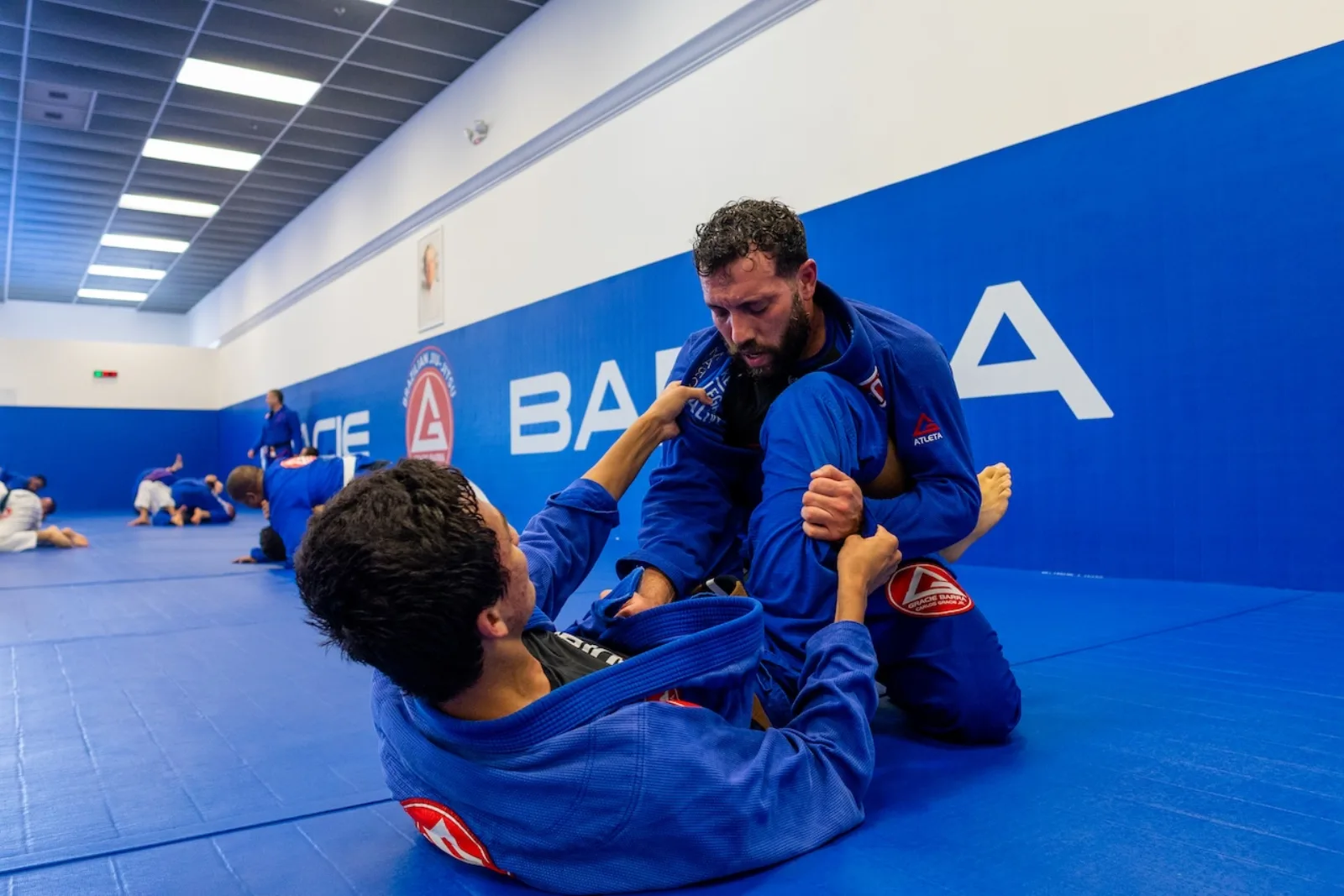
BJJ is trained in two formats. Gi training uses the traditional kimono (jacket and pants), which allows practitioners to grip the fabric for control and leverage — creating a slower, more technical game with a wider range of chokes and grips. No-Gi training removes the uniform (rash guards and shorts instead), which makes the game faster and requires tighter control without fabric grips.
Research on competitive no-gi BJJ has found that the removal of the gi significantly affects pacing, gripping strategy, and the frequency of certain submission attempts — making the two formats genuinely distinct skills, not just the same game with different clothing. (Spanias, 2022)
Most academies teach both. Beginners typically start with the Gi, as the slower pace and additional grip options make techniques easier to learn and apply.
The BJJ Belt System
BJJ uses a belt ranking system to mark progression. Adult belts run: white → blue → purple → brown → black. A black belt in BJJ represents roughly 10 years of dedicated training and is widely considered one of the most difficult rank achievements in any martial art.
What makes the belt system meaningful is that rank correlates with measurable skill. You cannot buy or test your way to a higher belt — you earn it through live rolling against people who will expose any gaps in your game. A 2024 study of 410 BJJ practitioners found that higher belt ranks showed significantly greater mental strength, resilience, grit, and self-efficacy compared to lower belts — suggesting that the BJJ journey builds psychological qualities alongside technical ones. (de Lorenzo-Lima, 2024)
Kids follow a separate belt system with more colors and a different progression timeline designed for their developmental stage.
Is BJJ Good for Self-Defense?
Yes — and arguably better than most alternatives for real-world situations. The reason: most untrained confrontations end up in a grapple rather than an exchange of clean strikes. BJJ teaches you exactly what to do when grabbed, tackled, or taken down. You learn to escape holds, create distance, and control a situation without needing to throw a punch.
Hélio Gracie designed the art specifically so that a smaller person could neutralize a larger aggressor. That philosophy is still central to how BJJ is taught today.
What Are the Benefits of Training BJJ?
The physical benefits are well-documented — BJJ improves cardiovascular fitness, builds functional strength, increases flexibility, and produces measurable improvements in body composition. But the benefits that keep long-term practitioners training are often the ones that happen off the mat:
- Problem-solving mindset — BJJ trains you to stay calm and think clearly under pressure
- Resilience — you get tapped constantly as a beginner and learn to reset and keep going
- Community — BJJ gyms develop unusually tight-knit teams because you train so closely together
- Confidence — knowing you can defend yourself changes how you carry yourself everywhere
Research into BJJ's sociopsychological effects has found that training contributes to positive development in youth — including improved self-regulation, social skills, and emotional resilience. (Blomqvist Mickelsson, 2020)
Who Is BJJ For?
Everyone. That sounds like marketing language, but in BJJ it's structurally true — the art is explicitly designed for people who lack size and strength advantages. Adults in their 40s and 50s train BJJ effectively because technique compounds over time; a purple belt with 6 years of training routinely handles much larger, stronger white belts.
Kids as young as 4 train BJJ in age-appropriate programs. Women make up a significant and growing percentage of BJJ practitioners worldwide. Athletes cross-train BJJ to improve body awareness and ground skills. Beginners with zero martial arts experience walk into their first class every day.
How Do I Start?
You need almost nothing to begin — comfortable athletic clothes and willingness to try. Most academies, including ours, will loan you a Gi for your first class. There's no fitness prerequisite and no prior martial arts experience required.
At Gracie Barra Davenport, our adult BJJ program runs classes Monday through Friday — both midday and evening — with a welcoming environment for complete beginners. Book your first class here and come see what BJJ is actually like from the inside.