
What Is Muay Thai? The Complete Beginner's Guide
The Art of Eight Limbs explained — where it comes from, how it works, and what you'll actually experience in your first class.
Muay Thai is a striking martial art and combat sport from Thailand. It is nicknamed the "Art of Eight Limbs" because it uses eight points of contact — two fists, two elbows, two knees, and two shins — compared to four in boxing or six in kickboxing. This makes it one of the most comprehensive and effective striking systems ever developed.
Today, Muay Thai is the foundation of striking in mixed martial arts, practiced by millions worldwide, and one of the best full-body workouts available to anyone regardless of athletic background.
Where Does Muay Thai Come From?
Muay Thai's roots stretch back several centuries in Thailand, where it developed as a military combat system and eventually became the country's national sport. Fighters trained to use their entire body as a weapon — shins hardened through conditioning drills, elbows sharpened for close-range damage, knees devastating in the clinch.
Traditional Muay Thai bouts are accompanied by live music from a sarama band and preceded by the Wai Kru — a ritual dance that honors the fighter's teacher and gym. These cultural elements remain central to the sport in Thailand today.
In the West, Muay Thai became widely popular in the 1990s through K-1 kickboxing competitions and later through the UFC, where its striking techniques proved effective against every other martial art.
What Makes Muay Thai Different from Other Striking Arts?
Most martial arts restrict the tools you can use. Boxing allows only punches. Taekwondo emphasizes kicks. Karate allows both but limits targets. Muay Thai allows — and teaches — all of the following:
- Punches — jab, cross, hook, uppercut
- Kicks — roundhouse, teep (push kick), switch kick, low kick, head kick
- Elbows — horizontal, diagonal, spinning, downward — in close range
- Knees — straight knee, flying knee, diagonal knee in the clinch
- Clinch — the standing grappling range unique to Muay Thai, used to control opponents and land knees and elbows
The clinch is what separates Muay Thai from most other striking arts. Rather than breaking from close contact (as boxing does), Muay Thai fighters are trained to work inside the clinch — sweeping, off-balancing, and attacking with knees. It gives you a complete toolkit for every range of a stand-up fight.
What Happens in a Muay Thai Class?
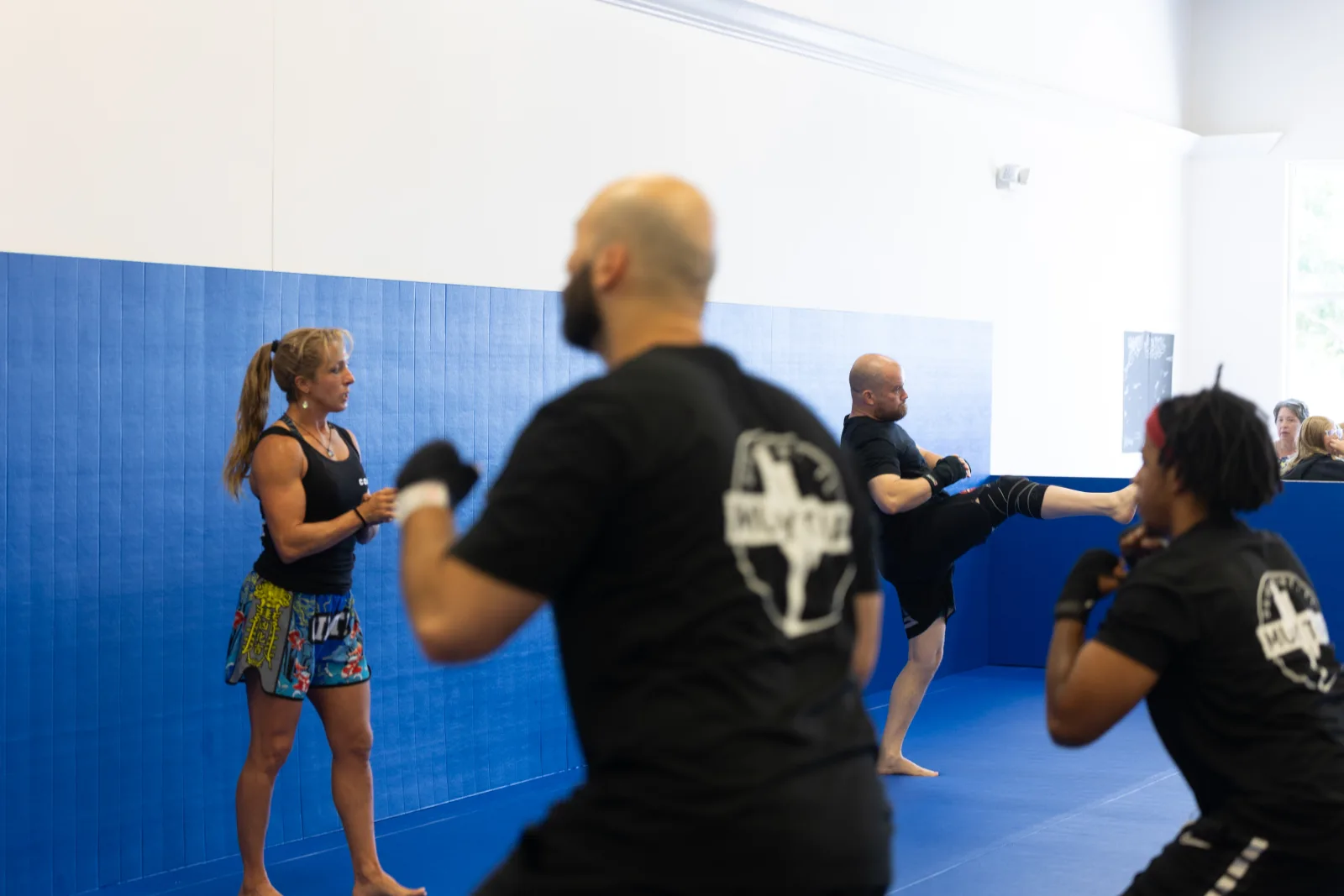
A typical Muay Thai class at Gracie Barra Davenport runs about an hour and follows a structure like this:
- Warm-up — jump rope, shadowboxing, dynamic stretching (10–15 minutes)
- Technique instruction — the coach demonstrates a technique or combination and students drill it (20–25 minutes)
- Pad work — students work in pairs, one holding Thai pads while the other practices combinations (10–15 minutes)
- Bag work or conditioning — heavy bag rounds or bodyweight conditioning circuits (10 minutes)
- Cool-down and stretching (5 minutes)
Sparring (controlled live practice) is introduced gradually as students develop technique and control. Beginners are not thrown into sparring on day one.
Is Muay Thai Good for Fitness?
Exceptionally. A single Muay Thai class burns 600–1,000 calories depending on body weight and intensity — more than running, cycling, or most gym programs at the same duration. It builds cardiovascular endurance, muscular strength (particularly in the core, hips, and legs), coordination, and flexibility simultaneously.
More importantly, it's engaging. The learning curve — new techniques, combinations, pad work with a partner — keeps training interesting in a way that treadmill cardio simply cannot. Students who hate the gym often find that they genuinely look forward to Muay Thai class.
Is Muay Thai Dangerous?
In a good gym with qualified instruction, Muay Thai is no more dangerous than any contact sport. Technique drilling and pad work — which make up the majority of class time for beginners — carry very low injury risk. Sparring is controlled and partner-dependent, and in a quality program, intensity is matched to your level.
The physical demands are real: Muay Thai is a hard workout and you will get tired. But most beginner injuries in martial arts come from poor instruction or mismatched sparring, not from the art itself.
Who Is Muay Thai For?
Everyone. Muay Thai is trained by professional fighters, complete beginners, people looking for fitness, adults in their 40s and 50s, and kids as young as 7 or 8. The techniques scale — pad work is adjusted to your level, and you're never forced into contact you're not comfortable with.
At Gracie Barra Davenport, our Muay Thai classes in Davenport welcome all ages and fitness levels. No experience required — just show up ready to learn.
Muay Thai vs. BJJ: Do I Have to Choose?
You don't. In fact, combining Muay Thai and BJJ is one of the smartest training choices an adult can make. Muay Thai covers stand-up fighting — striking, clinch, and range management. BJJ covers ground fighting — takedowns, positions, and submissions. Together, they give you a complete martial arts foundation and the toolkit used by every serious MMA competitor in the world.
Many students at Gracie Barra Davenport train both. The programs complement each other and the skills transfer — the body awareness from BJJ makes you a better clinch fighter; the conditioning from Muay Thai makes you a harder grappler.
How Do I Start?
You need very little to start Muay Thai — athletic clothes, some water, and the willingness to try. For your first class, we can loan you gloves. As you progress, you'll want your own gloves (16oz recommended for beginners), hand wraps, and a mouthguard.
See our Muay Thai program page for the class schedule, or book your first class here.